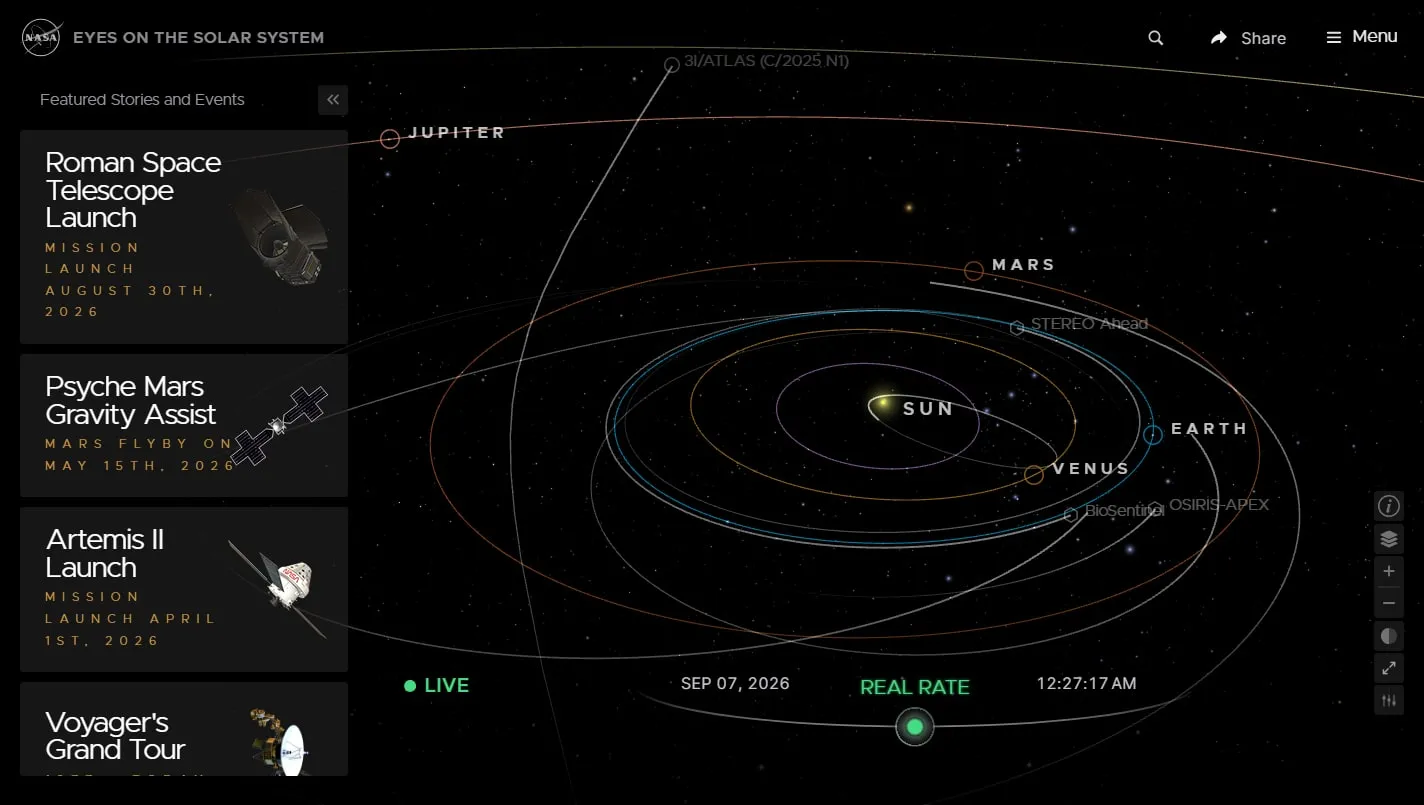
NASA Eyes on the Solar System places planets, moons, asteroids and missions inside a navigable three-dimensional model. Time controls and guided stories make it possible to inspect an orbit, follow a spacecraft or understand the geometry behind a mission event.
Start with a destination
Choose a planet, moon or mission from the interface instead of trying to navigate the entire model unaided. Once selected, rotate the view and adjust distance until the object’s orbit and its neighbours make sense together.
Use time as a control
Run the clock forward or backward to see positions and trajectories change. Slowing down around a flyby or orbital insertion makes the path easier to understand than viewing a static diagram detached from the event.
Remember what the model represents
The visualisation is built from scientific data but still uses scaled graphics, labels and camera choices to make enormous distances legible. Use it to understand relationships and mission geometry, not as a live optical view through a telescope.
Things to know
- It is a data-driven model rather than live imagery.
- Distances, object sizes and lighting may be adjusted for legibility.
- WebGL performance and loading time vary substantially by device.