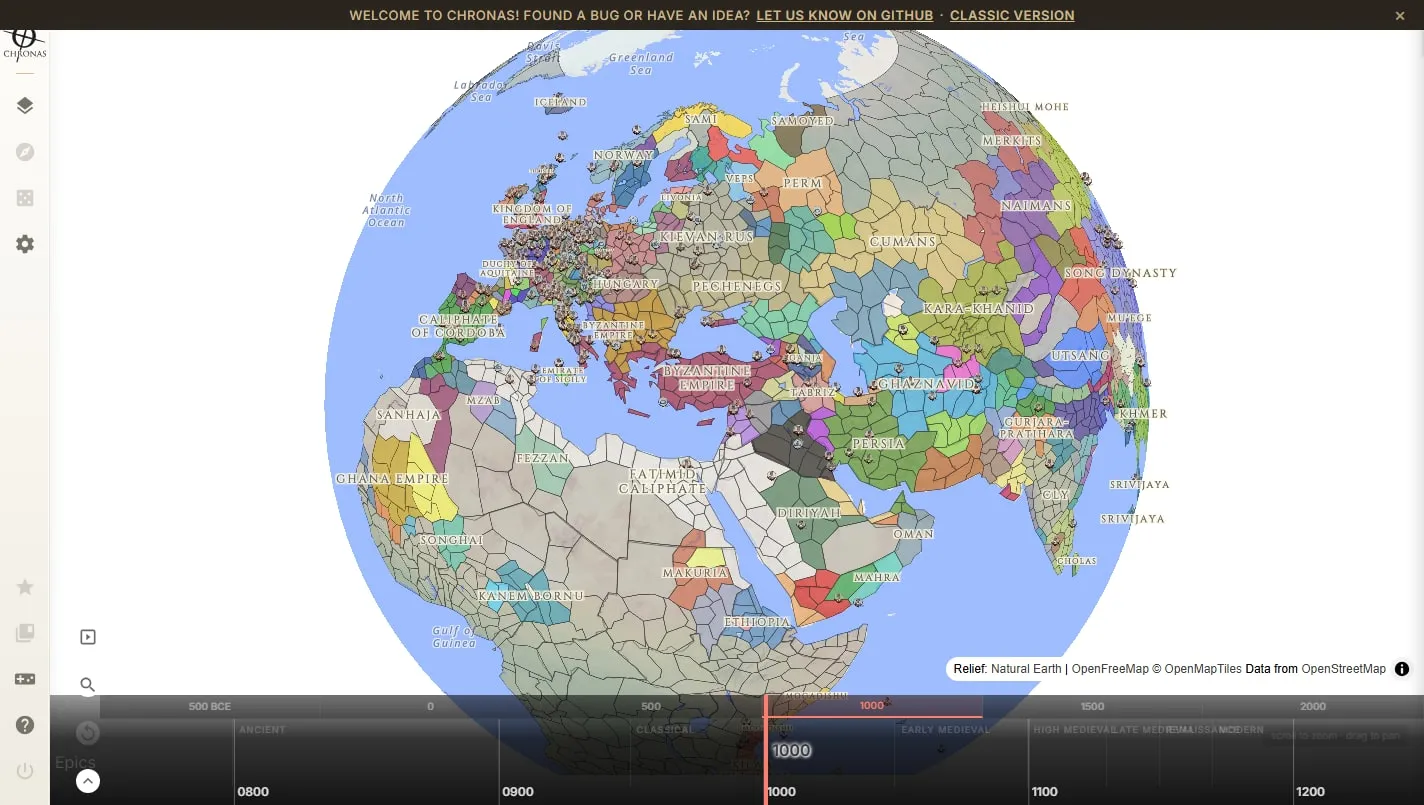
Chronas combines a historical world map with a timeline and layers for political, cultural and religious information. Instead of treating history as a sequence of disconnected dates, it lets you hold the place still and watch the surrounding world change.
Begin with a date and place
Move the timeline to a period you care about, then zoom into a familiar region. Holding one variable steady makes the map much easier to read: compare the same place across time before trying to understand the entire world at once.
Use the layers as questions
Political borders are only one view of a period. Switch between the available categories and open individual records to ask whether control, culture, religion and population are telling the same story in the selected region.
Check important details elsewhere
A world-spanning historical map has to simplify uncertain dates, overlapping authority and disputed boundaries. Treat Chronas as a route into a subject, then follow its references and specialist histories before relying on a precise border or label.
Things to know
- Historical borders and labels involve interpretation and simplification.
- Coverage and detail vary considerably by place and period.
- The dense WebGL interface is awkward on small or slower devices.