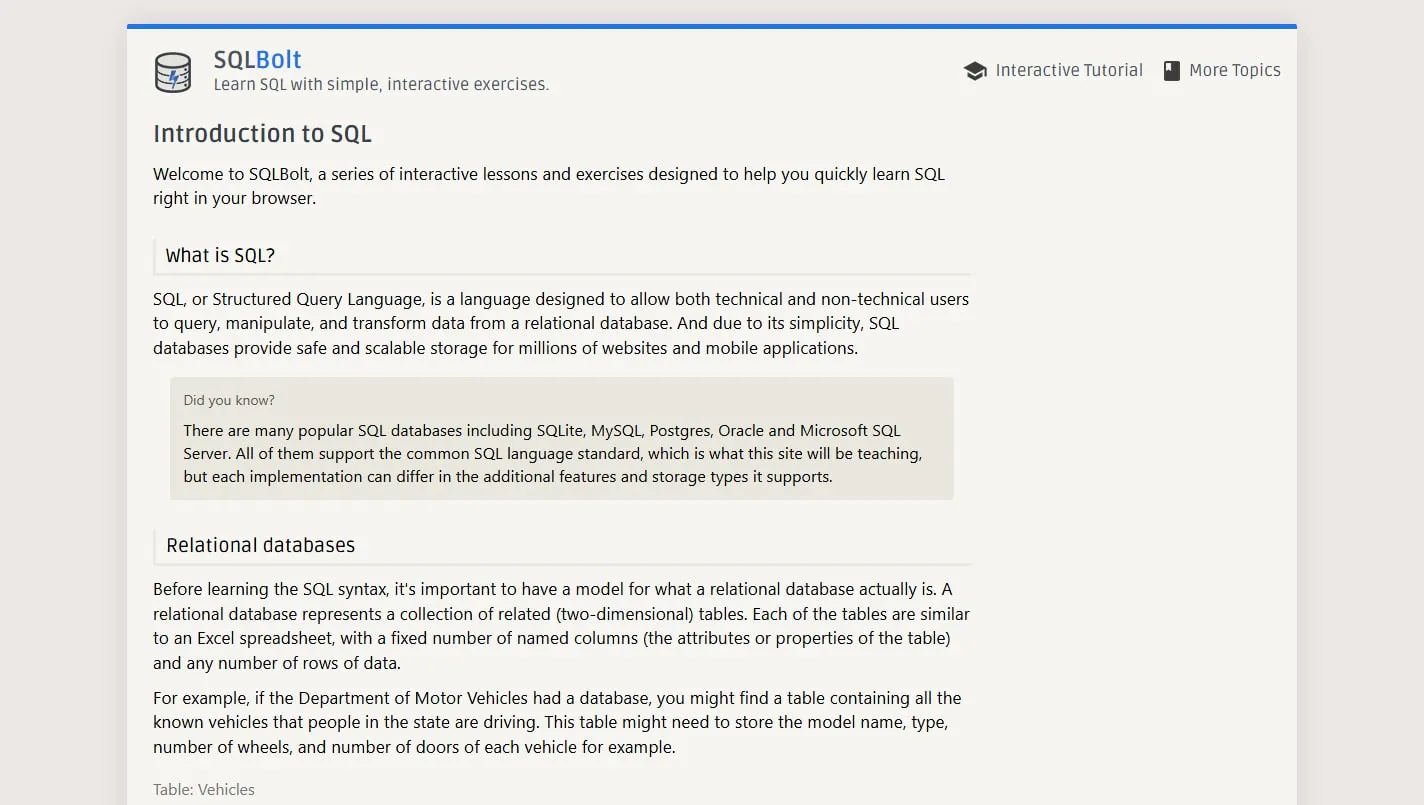
SQLBolt pairs concise explanations with browser exercises that run against small tables. The sequence moves from SELECT and filtering through joins, aggregates, data changes and table definitions, making it a useful first encounter or a quick refresher.
Start with readable queries
The early lessons introduce one clause at a time and keep the example tables visible. This makes it possible to predict the expected rows before running a query, which is a better habit than repeatedly changing syntax until an answer appears.
Build towards relationships
Once filtering and sorting are comfortable, the exercises introduce joins and aggregate expressions. Pay attention to which table owns each column and how duplicate rows arise, because those details matter far more in real databases than typing speed.
Use it as a foundation
SQLBolt covers the common language shared by many relational databases. Finish the exercises, then repeat the ideas in the database you expect to use, checking its documentation for differences in types, functions and schema management.
Things to know
- SQL syntax and behaviour differ between database products.
- The small teaching datasets do not expose performance or indexing problems.
- Production concerns such as permissions, migrations and backups are outside its scope.