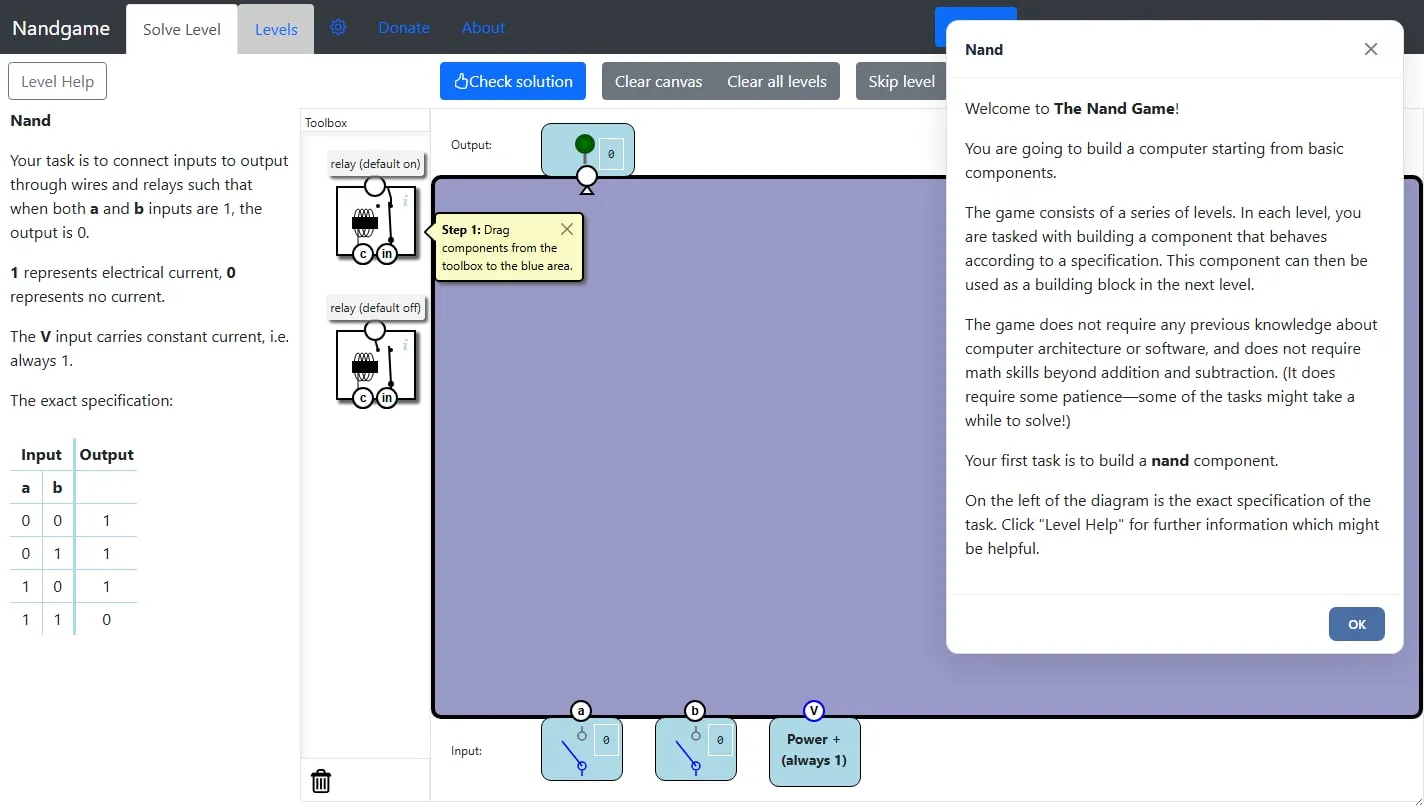
Nandgame teaches digital logic by asking you to construct each part of a computer yourself. It begins with the NAND gate, then gradually turns the components you have made into arithmetic, memory and a small programmable machine.
Begin with one dependable rule
The opening levels explain the behaviour of a NAND gate, then give you inputs, outputs and a work area in which to reproduce a required truth table. You learn the idea by making a circuit behave correctly rather than memorising a page of notation.
Reuse what you understand
A completed component becomes a building block for later levels. That progression makes abstraction tangible: switches become logic gates, gates become arithmetic and storage, and those parts eventually become a computer you can recognise.
Debug slowly
When a circuit fails, test individual inputs and follow the signal from left to right. Nandgame rewards patient diagnosis more than guessing, and a neat layout makes it much easier to see whether the error is in the design or one misplaced wire.
Things to know
- Later levels become demanding without much conventional tutorial text.
- Dragging and wiring components is awkward on a small touchscreen.
- The computer model is deliberately simplified for teaching.